oyediran-solicitors.co.uk presents:

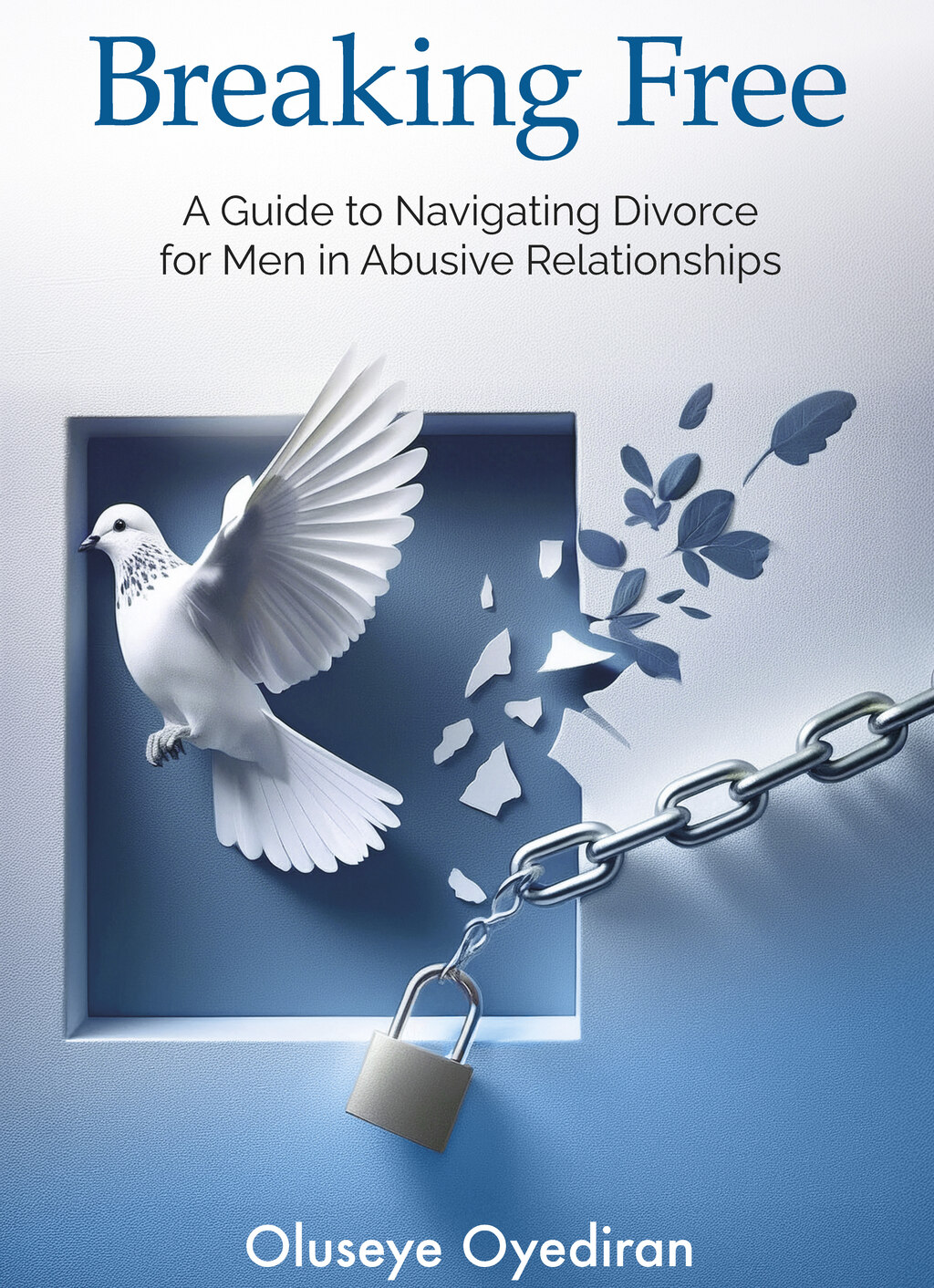
Breaking Free - A Guide to navigating divorce for men in abusive relationships

When a man is abused by his partner, he often suffers twice: first at home, then in silence.

He calls it stress. A bad patch.
He stays for his children, keeps going, keeps hoping.

Meanwhile, coercive control tightens, fear deepens, and one question grows impossible to ignore: where do I even start?

Frank knows that question well.
He was still paying the mortgage the night she slapped him in front of his children.
He slept on the couch of his own home for months, broke, in debt, and paralysed by the fear of losing his kids.

If any part of Frank's story sounds familiar, this guide was written for you.

Breaking Free - A Guide to Navigating Divorce for Men in Abusive Relationships, written by family law solicitor Oluseye Oyediran, is a plain English legal guide for men in England and Wales navigating divorce and domestic abuse.

https://www.amazon.co.uk/Breaking-Free-Navigating-Divorce-Relationships-ebook/dp/B0GHZGFNVX/

It puts the law firmly in your corner: legal protections for male victims, safe evidence documentation, what to expect from family court, and how child arrangements and financial settlements are resolved.

Frank's journey takes him from that couch to freedom, secured shared custody, and a fair financial settlement.

This guide is not about revenge.
It is about legal clarity, practical protection, and a credible path forward to a fresh and fair start.

You should not, and do not, stand alone in the pursuit of fairness.
The law is on your side.

https://www.amazon.co.uk/Breaking-Free-Navigating-Divorce-Relationships-ebook/dp/B0GHZGFNVX/


About the author

Oluseye Oyediran BA (Hons), LL.B (Hons), B.L

Early in his career, Mr Oyediran believed male victimisation by partners was heartbreakingly rare.


As his reputation for handling these matters with dignity and discretion spread through word of mouth, the trickle became a current, and the current became a revelation.

It became devastatingly clear that the real issue was not the frequency of the abuse; it was the weight of silence.

A silence most profound in communities with strong patriarchal traditions.


Traditions where admitting to being beaten or controlled by a wife or partner is not just a personal failure; it is a betrayal of a cultural script.


Exacerbated by the lack of targeted legal support, leaving survivors profoundly isolated and underserved.

This guide is his way of reaching through the isolation and placing a steady hand on a stooped shoulder.


It is the result of conversations he has had in the quiet of his office, now written for the man who cannot make the call or cannot sit across the desk from him.

It is his quiet, unwavering promise that the silence ends here.
You are not alone. There is a way out.

What's inside

This guide is a practical, plain-English roadmap for men navigating divorce while experiencing domestic abuse in
England and Wales.


It explains what the family law process looks like in real life, for example, working with solicitors, protections, important
evidence, key stages, and forms.


The goal is simple: help you make safer choices and avoid mistakes.
This guide is not anti-women.


It does not encourage retaliation, harassment, or breaches of court orders.
It is not a promise of a particular outcome, a shortcut through the courts, or a ‘win at all costs’ playbook.
It is not legal advice and cannot replace a solicitor who knows your facts.


And if you are in immediate danger, this guide is not your emergency response. Call 999 (or 101 for non-emergencies)
and get urgent help.


Use this guide to get informed and prepared. 


Then get tailored advice for your specific case.

This guide uses the journey of a client avatar named Frank, from hopelessness to breaking free.
It is written in plain English and divided into 3 sections, that cover 13 chapters.
I have provided a brief overview of the first six chapter of the guide.

Here's a snippet of  Frank's story:
The rain hammered against my office windows that November evening.
I heard the front door open downstairs. Heavy footsteps climbed slowly, pausing on each step.


A man appeared in my doorway, soaked through.
Water dripped from his jacket onto the carpet.
His shoulders hunched forward as if he were bracing for impact.

Dark circles shadowed his eyes.
He looked as if he hadn’t slept properly in weeks.


“Mr Oyediran?” “Jon said… he said you might be able to help.”
“Please,” I said. “Call me Olu. Come in. Sit down.”
He lowered himself into the chair across my desk.


His hands trembled slightly.
He pressed them flat against his thighs to steady them.
For a long moment, he stared at the floor.
“I don’t know where to start,” he said finally.
I’ve heard those words many times.
Men come to my office broken.
They come confused, ashamed, terrified.
They’ve been told their experiences don’t count.
Society tells them men cannot be victims.
But they are. And they deserve help.
“Start wherever feels right,” I told him. “We have time.”
His name was Frank. He was forty-two years old.
Once, he managed travel services for a large corporation.

Now he drove for Uber.
He had three children: Emma, 11; Jake, 9; and Tom, 7.
He was soaking wet because he’d walked here.
His car had broken down months ago.
His wife controlled the family finances.
He couldn’t afford the bus fare, let alone a taxi.
“I need to know,” he said, looking up at me finally.
“Is what’s happening to me… abuse?”...


Chapter 1

01

Some issues discussed include:
What the Law Says About Domestic Abuse.
Recognising the Different Forms of Abuse.
Evidence: Documenting What’s Happening.
FAQs for example:
What if my partner threatens to accuse me of being the
abuser?

Chapter 2

20

Some issues discussed include:
Finding the right solicitor.
Domestic Abuse Evidence to Qualify for Legal Aid
What to expect in the first meeting with your solicitor.
Understanding costs.
FAQs for example:

Should I wait until I have evidence of abuse before seeing a
solicitor?


Chapter 3

28

The Legal Framework: Non-Molestation Orders.
Occupation Orders: Who Stays in the Home.
Emergency Applications: When you need protection now.
Domestic Abuse Protection Orders and Notices.
Police Involvement: Creating Official Records.
Practical Guidance: What to do when violence occurs.
FAQ's for example:
Will I have to leave my home if I apply for a protection order?


Chapter 4

40

The Legal Framework: How No-Fault Divorce Works.

What Divorce Does and Doesn’t Do.

Practical Guidance: Applying for Divorce.
FAQ's for example:
Can my spouse stop the divorce?


Chapter 5

66

The Legal Framework: Evidence in Family Proceedings.
Types of evidence.
Practical Guidance: What to Gather Now.
What NOT to Do When Gathering Evidence.
FAQ's for example:
Can I record conversations with my partner without their
knowledge?


Chapter 6

74

Non-Court Dispute Resolution (NCDR)
Understanding Mediation Information and Assessment Meeting (MIAMs).
The Legal Framework: When MIAMs Are Required.
The MIAM Exemption for Domestic Abuse.
Children and Family Court Advisory and Support Service (CAFCASS): What They Do.
Your Quiet Witnesses.
Navigating the MIAM Process.
FAQ's for example:
What if I can’t afford the MIAM fee?


What readers said about this book

Giese U.

Where has this book been all my life?!

Finally, a book that speaks to an hugely underestimated gender issue that every one of us needs to be aware of! Men too often are the abused and not the abusers!

As a woman over the years it was very encouraging to have a lot of support for women and girls. At some point though, it went over the top, and for me personally it became particularly annoying when every man and his dog - well maybe not the dogs but wayyy too many men - were taking up the issue of the ‘girl child’. I often expressed my frustration: “why don’t they focus on the boy child at all?” The answer was quite simple: it wasn’t a money spinner in the non-profit sector.

Ethical and moral issues aside, the unfortunate facts hidden within that fact, were the very real and unmet needs of boys and men in today’s ever rapidly changing socio-political and socio-economic landscape.

As a womanist, (and I am adamant about the distinction between feminist and womanist), it was important to me to uphold masculinity and all it means to me as a cis and heterosexual woman, even as we tackled age old gender inequalities.

As mother of a son and grandmother of a grandson I have a vested interest in the wellbeing of my male offspring and those of all my sister humans for generations to come.

As a FEMALE divorcee, I could have learned from reading this during my abusive marriage and the ugly divorce that followed.

As a psychologist, I celebrate every tangible act of inclusion when it comes to identifying and tackling all gender inequalities.

As a mother of daughters, I would hope that all heterosexual women of the marriage persuasion would be moved to introspection by this book. A word is enough for the wise.


As a lover of men I embrace you all with love. You deserve to be seen, heard, cherished and loved. You do not deserve abuse, nobody does! With this book we can hope as a village, to uphold your dignity and the invaluable role you play in society.

I hope that this book will be in more than just a few Christmas stockings in a few months time.


Omoba Oladele Osinuga

Essential domestic violence victim tool kit


Breaking Free by Oluseye Oyediran is one of the most necessary and unflinchingly honest works to emerge in the domestic‑abuse space in recent years. After more than two decades working across Europe, Africa, the Caribbean, and the Americas on victims’ rights, human trafficking, gender‑based violence, and justice‑sector reform — with domestic violence as a constant thread — I have seen firsthand how male victims are routinely erased from the narrative.

International frameworks such as the UN Declaration of Basic Principles of Justice for Victims of Crime and Abuse of Power (1985) and the Commonwealth Guidelines for the Treatment of Victims of Crime (2003) underpin national standards including the Victims’ Code in England and Wales. Yet, as Oyediran’s portrayal of Frank’s experience makes clear, victims who fall outside traditional expectations still struggle to be recognised, believed, or protected. Although the book is anchored in civil and family‑law proceedings, its insights are directly relevant to criminal‑justice contexts where coercive control escalates into criminality and the Victims’ Code becomes fully engaged.

What elevates this book is its granular, lived‑experience precision. Oyediran captures — with clarity and restraint — the slow erosion of self‑worth, the psychological manipulation, the financial control, and the social disbelief that male victims often endure. His narrative confronts a truth that institutions still hesitate to acknowledge:

men can be victims too — and their suffering is no less real, no less damaging, and no less deserving of protection.

From a professional standpoint, the book’s greatest strength lies in its practical roadmap for navigating divorce under coercive control. Oyediran distils the process into clear, actionable stages: documentation, emotional detachment, legal strategy, safeguarding considerations, and the rebuilding of identity. This mirrors the victim‑centred, rights‑based frameworks I have helped develop in Kosovo, Belize, Nigeria, and within international tribunals. His approach aligns with best practice: restore agency, prioritise safety, and empower the victim to reclaim autonomy.

For practitioners in family law, safeguarding, policing, counselling, and social services, this book is a timely and necessary wake‑up call. It challenges entrenched assumptions about who can be harmed and how institutions respond. For male victims, it offers something even more vital: validation, language, and a structured pathway out of the fog of abuse.

Oluseye Oyediran has written a courageous, necessary, and deeply humane guide. Breaking Free deserves a permanent place in the professional toolkit of anyone committed to strengthening victim‑protection systems and ensuring that no survivor — male or female — is left unseen.

Gary

Outstanding!

I was spellbound reading this book. The Author has done great justice to a phenomenon affecting a lot of Men in the African setting, yet this abusive challenge is hardly ever mentioned in the open!

The Tinderbox has been flung open ! The resulting cacophony will go on and on !


This book is a powerful and necessary resource for men facing one of the most difficult periods of their lives. The author approaches a sensitive subject with honesty, compassion, and practical insight, offering guidance that is both emotionally supportive and actionable.

What stands out most is the book’s ability to validate experiences that are often overlooked. It speaks directly to men dealing with emotional, psychological, and verbal abuse, while also providing clear steps for rebuilding confidence, protecting mental health, and navigating the legal and personal challenges of divorce.


The writing is straightforward, relatable, and encouraging without being overly complicated. Whether someone is currently in an abusive relationship, considering separation, or recovering after divorce, this book provides reassurance that healing and freedom are possible.


A valuable read that shines light on an important issue and offers hope, strength, and direction to those who need it most.